US Tariffs to Hit Key Indian Sectors: What’s at Stake in 2025?
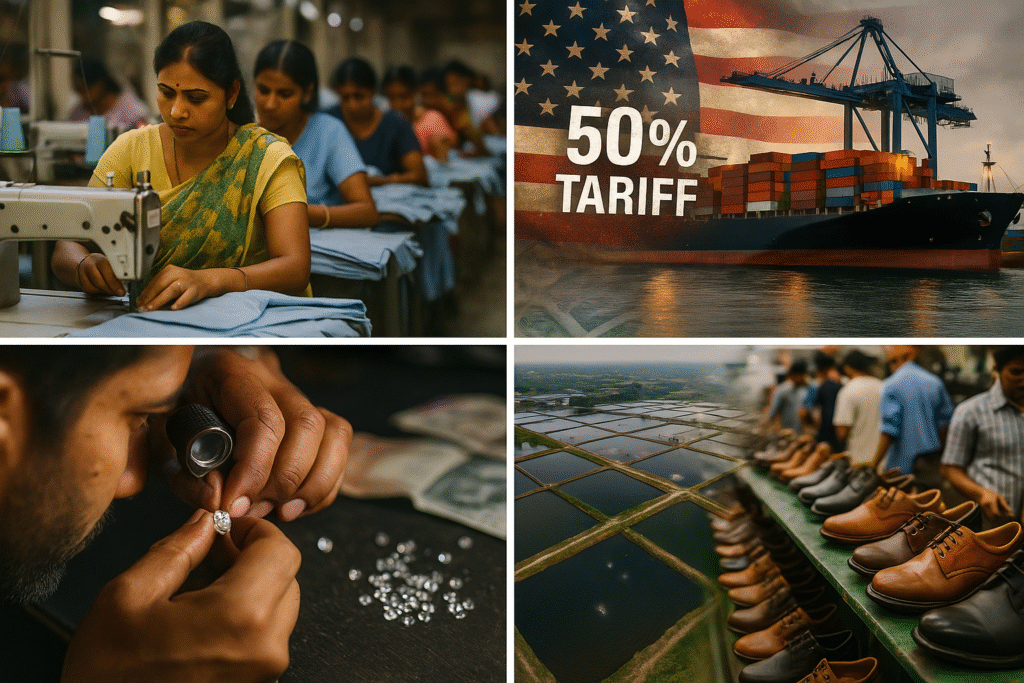
The United States’ 50% tariff on key Indian exports is shaking up trade flows, pricing power, and employment across India’s most labor-intensive industries. Here’s who gets hurt, who’s shielded for now, and what India can do next.
Introduction: A Trade Earthquake in the Making
The US remains one of India’s largest export markets. A sudden 50% tariff on a wide basket of goods raises costs for American buyers and squeezes Indian margins, threatening production schedules, cash flows, and jobs across MSME clusters.
Textiles & Apparel: The Largest Casualty
From Tiruppur’s knitwear lines to NCR’s stitching floors, textiles and apparel face the steepest demand shock. Order books may shrink sharply as cost parity shifts toward competitors such as Bangladesh and Vietnam.
- Working capital stress and potential layoffs in MSMEs
- Pressure on women-heavy garment workforce
- Falling export realizations due to discounting
Gems, Jewelry & Carpets: Losing Luster
Gems & Jewelry
Surat and Mumbai’s polishing and design hubs could see US buyers divert to duty-favored sources. High-skill employment is at risk if volumes slide.
Carpets & Handicrafts
Clusters such as Agra, Bhadohi, and Panipat lose price advantages; rival producers in Turkey and Iran can gain share.
Seafood & Leather: Rough Waters Ahead
Seafood (Shrimp)
Andhra Pradesh’s shrimp farmers and processing plants face cancellations as landed prices in the US surge.
Leather Goods & Footwear
Units across Kolkata, Agra and Tamil Nadu risk order deferrals; compliance costs plus tariffs erode competitiveness.
Chemicals, Auto Components & Agriculture: A Wider Net
Beyond traditional sectors, parts of chemicals, auto components, and agri exports (basmati, spices, tea) may see buyers switch geographies, hitting MSME suppliers downstream.
Which Sectors Are Safe—for Now?
Pharmaceuticals, electronics/IT services, and select energy products appear outside the immediate tariff scope. Still, policy is fluid; exporters should monitor signals closely.
India’s Next Move: Policy & Strategy
- Relief measures: enhanced duty drawbacks, interest subvention, faster GST refunds
- Diversification: LATAM, Middle East, Africa, ASEAN
- Trade diplomacy: accelerate India-EU and India-UK tracks
- Value addition: shift to branded, higher-margin products
Global Context: Will This Escalate?
Retaliatory tariffs could broaden frictions, raising uncertainty and hedging costs. India’s calibrated response will aim to protect jobs while avoiding prolonged escalation.
FAQs
- 1) Why did the US raise tariffs?
- Stated reasons include protecting domestic industry; analysts also cite political calculus.
- 2) Which sectors are most exposed?
- Textiles, apparel, gems & jewelry, carpets, seafood, leather, chemicals, and some agri items.
- 3) What happens to MSME jobs?
- Compression in orders risks layoffs unless relief and market-diversification soften the blow.
- 4) Are pharma and IT safe?
- They appear unaffected for now but should remain vigilant.
- 5) What policy moves can help?
- Export credit, cost relief, faster logistics, and FTA progress with the EU/UK.
- 6) Where can I track tariff changes?
- See the WTO and official US/India trade notices.
Conclusion: A Defining Moment
The tariff shock is a stern test of resilience. Swift policy support, smarter value addition, and diversified markets can turn disruption into a durable pivot for India’s export engine.
 English
  Hindi
Hindi